
"unpaid wages"
1290 article(s) found

Coffee history Coffee trees were introduced to Puerto Rico from Martinique
Coffee trees were introduced to Puerto Rico from Martinique in 1736. Early coffee was mostly grown by immigrants from Corsica. By 1896, Puerto Rico was the sixth largest coffee exporter in the world, with most going to France, Italy, Spain and Cuba. Coffee plantations flourished in the 19th century, but sugar cane and drug cultivation rose

Yaocote chooses coffee to grow on three farms in the southwest of Puerto Rico.
Boutique coffee (specialty coffee) is also called specialty coffee selection coffee. It refers to coffee made from a small number of raw beans with excellent taste grown in an ideal geographical environment. Depending on the special soil and climatic conditions in which they grow, they have outstanding flavor. After strict selection and classification, this kind of coffee is hard in texture, rich in taste and stylish.

Can farmers sell whole coffee berries instead of beans? Is that better?
It is generally assumed that smallholders need to cooperate to collect, process, and trade directly harvested fruit in order to be competitive and profitable in the coffee industry. Smallholder farmers will never escape the cycle of brokered exploitation leading to poverty as long as they are not linked to certified cooperatives, testing laboratories, processing plants and import-export units. This view may be basically correct
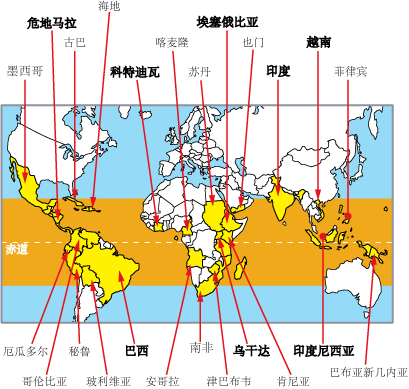
There are 53 coffee producing areas in the world. Puerto Rico Coffee.
In 1736, coffee trees were introduced from Martinique to Puerto Rico (Puertp Rico). Most of the early coffee was grown by immigrants from Corsica. By 1896, Puerto Rico was the sixth largest exporter of coffee in the world, with most coffee shipped to France, Italy, Spain and Cuba. 19th century coffee manor

Introduction to the Flavor and Taste of Kilimanjaro Coffee Manor in Tanzania
The types of rainfall can be divided into bimodal distribution and unimodal distribution. The areas with double bee rainfall include the provinces around the Lake Victoria basin, the northeast highlands, the coastal and inland northeastern. The bimodal rainfall area is characterized by two rainy seasons. The short rainy season occurs from September to December. The total rainfall can reach 200-500 mm. The long rainy season occurs from March to May.

Flavor description of Ugandan coffee bean taste graded production area introduction of taste variety manor
Ugandan coffee beans taste graded regional flavor description taste variety manor introduces the tenacious resistance of people all over Uganda to British aggression. In 1893, Britain sent troops to occupy the Kingdom of Bunioro, and King Kabarega led some of the people to wage guerrilla warfare for six years. In 1897, King Mwaanga of Buganda raised his army against Britain and later joined Kabarega in the Rango area.

Introduction to the method of processing the name of taste manor of varieties with flavor description of Ugandan coffee beans
The flavor description of Ugandan coffee beans introduces the tenacious resistance of people all over Uganda to British aggression. In 1893, Britain sent troops to occupy the Kingdom of Bunioro, and King Kabarega led some of the people to wage guerrilla warfare for six years. In 1897, King Mwaanga of Buganda raised his army against Britain and later joined Kabarega in the Rango region. In April 1899, two kings were captured

Introduction of Puerto Rican coffee flavor and taste introduction of high-quality coffee beans Puerto Rican coffee producing areas
Yaocote's choice of coffee, which is grown only on three farms in the southwest of the island, is fragrant and has a long aftertaste. This kind of coffee is very expensive and its flavor is comparable to that of any other coffee variety in the world. In the Yauco area, the coffee is owned and operated by local planters. The mountain climate here is mild, and the plants have a long mature period (from October to February of the following year).
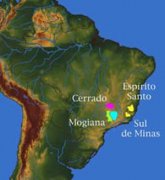
Introduction to the origin of coffee-what is the quality of Puerto Rico coffee? Puerto Rico.
In 1736, coffee trees were introduced from Martinique to Puertp Rico. Most of the early coffee was grown by immigrants from Corsica. By 1896, Puerto Rico was the sixth largest exporter of coffee in the world, with most coffee shipped to France, Italy, Spain and Cuba. Coffee farms flourished in the 19th century, but the rise of sugarcane and drug farming

Introduction to the characteristics of Ugandan Coffee Flavor Manor with thick and low acidity
The people of all parts of Uganda resisted the British aggression tenaciously. In 1893, Britain sent troops to occupy the Kingdom of Bunioro, and King Kabarega led some of the people to wage guerrilla warfare for six years. In 1897, King Mwaanga of Buganda raised his army against Britain and later joined Kabarega in the Rango region. In April 1899, the two kings were captured and the uprising failed. To make it easier to rule

The flavor and taste of Puerto Rico boutique coffee beans the characteristics of the manor producing area Larez Yaoke Coffee
Yaocote chooses coffee beans to be preserved in shells before they are shipped and will not be peeled off until the order is shipped to ensure the best freshness of the coffee. Relevant U.S. government staff, such as FDA and USEA, will also be present when the goods are submitted, and they work to monitor producers' compliance with federal regulations. There are also some staff from the local evaluation committee, he

Fascinating Coffee Yaocote Coffee Puerto Rican Coffee
Boutique coffee has a strict grading system. Generally, raw beans are preserved in parchment coffee beans in the form of endocarp after processing, and the endocarp is removed before export. Go through a strict grading process to ensure the uniformity of quality. And it is very important to preserve the protection in the process of transportation, such as the control of temperature and humidity, the control of ventilation, avoiding odor adsorption and so on.

How much is it to learn from a barista on the flip road from a backpacker to a barista? It doesn't matter.
Professional coffee knowledge exchange more coffee bean information please follow the coffee workshop (Wechat official account cafe_style) barista: I earn 3,000 yuan a month, it is impossible to lose you a shot! # A life-changing year in 2014, I gave up my stable job in Taiwan and went to Australia to work a holiday with my girlfriend. At first, I picked oranges on the farm and worked the night shift in a salad factory, then I worked the night shift.

The speakers of the fourth BlackWaterCrunch (Coffee Symposium), Pak Gu Zhe and Zhao Jiabao
BlackWaterCrunch, a coffee seminar hosted by BlackWaterIssue, will be held at the LW Convention Center in Seoul, South Korea on August 4th. Two of the speakers are from overseas, namely 2016WBrC champion Sakatani (Tetsu Kasuya, Japan) and 2014WBC runner-up Zhao Jiabao (Capo Chui, Hong Kong). Before the seminar, we BlackWaterIssue conducted an interview in advance. q)

The coffee beans of Puerto Rico in America have the characteristics of pure taste, aroma and heavy grain.
In 1736, coffee trees were introduced from Martinique to Puerto Rico (Puertp Rico). Most of the early coffee was grown by immigrants from Corsica. By 1896, Puerto Rico was the sixth largest exporter of coffee in the world, with most coffee shipped to France, Italy, Spain and Cuba. Coffee farms were once numerous in the 19th century
What is the reason for the decline of coffee in Puerto Rico?
Following Cafe (Wechat official account vdailycom) found that Fairview Cafe opened a small shop of its own. What is the reason for the decline of coffee in Puerto Rico? Puerto Rico has been in the news lately because its government, which has been saddled with $70 billion in debt for years, officially defaulted in August. Its awkward situation originated from the Spanish-American War of 1898.

The unique flavor of Ugandan coffee taste introduction to the characteristics of fine coffee in manor area
The people of all parts of Uganda resisted the British aggression tenaciously. In 1893, Britain sent troops to occupy the Kingdom of Bunioro, and King Kabarega led some of the people to wage guerrilla warfare for six years. In 1897, King Mwaanga of Buganda raised his army against Britain and later joined Kabarega in the Rango region. In April 1899, the two kings were captured and the uprising failed. To make it easier to rule

What do you need to learn if you want to open a coffee shop? the basic process of opening a shop.
a. The first is to prepare for the opening of the shop, this part of the abundance and frugality, generally speaking, to open a coffee shop in Beijing with an area of 200 square meters requires about 500000 yuan. b. Select the customer base according to the characteristics of their own core products, in most cases, the core products are not coffee itself, but for example: porcelain, carpets, handicrafts; special meals; special activities

Puerto Rico has a history of producing coffee for nearly 300 years. Why is it declining gradually?
Following Caf é (official Wechat account vdailycom) found that Puerto Rico, which has a history of producing coffee for nearly three hundred years, was one of the most productive regions in the world. Spanish explorers brought coffee from the French Louis XIV plantation to the island in 1736. The fame of Yao Konot's selection (Yaucono Selecto) was once with Kona and Kona of Hawaii

Puerto Rican coffee flavor taste manor producing area characteristics of fine coffee beans introduction to Larez Yaoke Coffee
Puerto Rico has been in the news lately because its government, which has been saddled with $70 billion in debt for years, officially defaulted in August. Its embarrassing situation originated from the Spanish-American War in 1898, when Spain surrendered Puerto Rico to the United States, making it a commonwealth of the United States in the Caribbean. Unlike the 50 native states,